Alright, I’m gonna write a testimony of my experience using TikTok a few years ago. This predated the proliferation of AI generated slop.
The app was surprisingly well designed… Too well designed…
It has a doom-scrolling casino-like infinite scroll design. You never know which video will show up next. Each swipe feels like you’re hitting the lever of a slot machine. Some may not think much of this, but this can put one in danger of the recommendation algorithm taking them to a place they wouldn’t expect to end up.
The videos themselves ranged from memes, to tutorials, to trolls and obvious rage bait. One of the more interesting features were the ones that allow for making reactions to other content, allowing for quite the interesting reactions and memes.
Occasionally, an ad will show up. These were surprisingly non-intrusive, and could be easily swiped passed. This seemed to promote a unique advertising META that encouraged advertisements to actually blend in with the other content on the platform, because as soon as people swipe and see a blatant McDonald’s ad, they would immediately swipe past it. This advertising system is something I actually have to give credit to, as it discourages the usual un-creative slop that usually plagues advertising.
As usual, I didn’t engage much with the comment sections of videos. I knew those were nothing but trouble since I saw the ones on YouTube. It didn’t take long to find everything from mundane insults to entire flame wars in the comments.
I also didn’t watch live streams on TikTok. It didn’t feel natural to me.
The more I used TikTok, the more I could feel my brain start to malfunction, with stress and anxiety levels peaking far easier than before I started using it. I only used TikTok sparingly. It wasn’t an every day thing. I only used it every few weeks, but even then, I could still feel the effects.
After around a year of usage, I deleted the account, and the app entirely.
Alright, let’s boil it own to the problems that I saw:
Accessibility Issues
Undocumented features
My hands are very finicky with touch screens. Sometimes a tap or a swipe may not register as a single tap or swipe. This lead to a problem: The app had a button I can press to like a video. I see it, I recognise the shape, I know what it’s for. Simple as that. But TikTok is an entirely different beast. It kept occasionally liking the video when I tapped the screen. I thought this was a bug, until I looked in deeper.
It turns out that TikTok has an undocumented ‘double-tap to like’ feature, that can not be disabled, and this is a problem. It felt like I wasn’t controlling the app. It felt like it was deciding to do stuff on it’s own. This is an example of railroading a feature that can effect users in a negative way.
Inconsistent design
When one swipes up or down, they expect to go to the next pr previous video, but TikTok railroaded a feature that allows for image slideshows to be posted. This wouldn’t be a problem if it wasn’t for one thing: the autoscroll. After a couple of seconds, it would automatically switch to the next slide. Not problematic yet? Well, did I mention that when you try to swipe vertically to change the video while the horizontal slide is changing, that it would cancel out the vertical scrolling? The horizontal slide change would take about a second to complete, and happened every 2 seconds. This vertical scroll-cancellation happened repeatedly, and pissed me off beyond explanation. I couldn’t filter out those slideshow posts, as they couldn’t be disabled. It’s almost as if I wasn’t in control of my own device again.
Obfuscated UI element names
While making an accessibility frontend using Tasker and AutoInput to overcome the above accessibility issues, I struck another issue: All the UI elements were obfuscated in a way that wasn’t consistent between app updates. This inhibits any accessibility software from recognising UI elements correctly and consistently, and makes it nearly impossible to make an app-specific accessibility overlay for TikTok, especially when UI element positions and sizes depend a lot upon the device itself, and the device’s settings. I’m pretty sure this is against Android’s accessibility guidelines for UX design, but I’m not a paperwork wizard, so what could I possibly know?
All I have to say is: GOOD LUCK USING THIS APP IF YOU’RE BLIND, LOL!
The usual social media crap
Doom scrolling infinite content machine
That platform was fill of garbage content, misinformation, and outright lies. This kind of stuff always shows up on user-generated content platforms like TikTok, but this time, it was exacerbated by the fact that on TikTok, you don’t browse for content (they do have a search feature, but it’s garbage). Instead, the algorithm feeds you what it ‘thinks’ you might like.
This can lead to a rabbit-hole effect, where you can start from knitting tutorials, and end up in some alt-right Qanon conspiracy niche that believes that a certain ethnic minority is drinking the blood from aborted fetuses or some shit, and the worst part is: the more these videos show up, the more watch time the algorithm sees, and thus, the more of this garbage is recommended by the same algorithm.
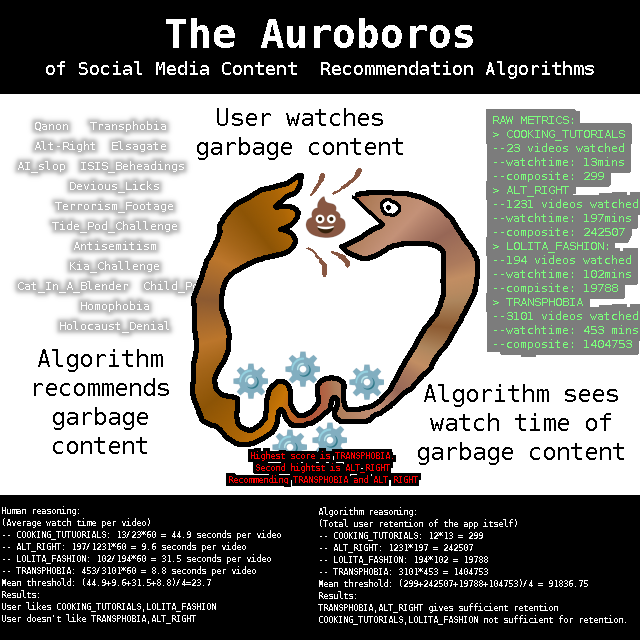
I think there’s a mathematical fallacy demonstrated in the image above…
The problem with these recommendation algorithms is that we don’t know how they work. We can, however, assume they keep total platform retention in mind for this. since they want to keep users on the app for as long as possible.
What keeps people on the platform longest? Why, just make it so time consuming to find content one actually wants to watch, and prioritise recommending shit that outrages people enough to start a flame war in the comments about it, send push notifications for each reply to these comments, and there’s the interaction and retention loop for ya.
This is an incredible method of distributing not just funny memes, but also rage bait, propaganda, and now with TikTok Shop existing, dick pill salesmen and other snake oil merchants.
Exploitable Ads
While I commend TikTok’s respectable effort to making a more sustainable advertising system than most other platforms do, this doesn’t change the simple fact that TikTok is rife with bad content. This is especially concerning when combined with the in-app advertising system, which makes the ads blend in with the actual content stream, making it hard to discern an ad from genuine content without carefully checking the content description each time you swipe, meaning any possible disclosure is therefore an afterthought in the user’s mind.
Online advertisers have a long lasting habit of poor quality control, and an eagerness to accept foreign political propaganda into the ads. Some astroturfing organisations and hate groups have used this method to spread their slop, but that’s an article for another day.
Push Notifications Galore
Imagine waiting for an important text message to come through, only to be flooded with random notifications that drown out the important stuff? Well, that’s the problem with platforms being too eager to escape the app they belong inside.
I’m a simple person when it comes to notifications. I enable phone calls, text messages, emails, and important web server notifications. Everything else can get bent.
Want to recommend content for me to watch? Wait for me to open the app and check. Online content doesn’t usually have that narrow of an expiry date. It can wait.
Want to notify me about comments and replies? Wait for me to check the app. It can wait.
I cracked down on this push notification stuff a long time ago. I realise that their only existential purpose is to hook you back into the app, and encourage an addiction cycle in the user. It’s sick, it’s predatory, it’s just bad for the attention span of the user (as if TikTok’s content format wasn’t already bad enough for that).
Chinese spyware concerns
One of the main concerns of the time is that TikTok’s business operations were based in China, and you know what China is like. The CCP want to spy on everyone.
Many people are relieved to hear that the US have obtained TikTok, but I’m afraid the US is no better than China, with all their bad privacy laws, data brokers and all that fun stuff.
I would go as far as to say that almost every centralised social media platform has this issue in common, as all the users’ data is stored in one place, easily accessible by law enforcement, foreign spies, or those participating in industrial espionage and social engineering attacks.
Don’t expect any of these platforms to be keeping your personal information safe, especially when many of them have a profit motive to sell users’ personal information.
TikTok Clones
The only thing worse that TikTok is a TikTok clone.
All of a sudden, every other platform started blatently copying TikTok, often with even worse results, which is funny. It’s usually the Chinese who make knockoff products of US goods, not the other way around!
YouTube made YouTube Shorts, which is somehow even worse than TikTok.
META/Facebook have cloned TikTok, with things like Instagram Reels.
Alternatives to TikTok
and other platforms like it
Decentralised and federated social media platforms like Mastodon, Peertube, and others exist, that can be self hosted on one’s own server if they wish. Loops is probably the closest to TikTok that these get (being an obvious clone), with Peertube being a close second (Peertube is a good YouTube clone). Most of these federated solutions are open source software, and can even cross-federate with each other in many situations.
While it is possible to gather metadata about everyone’s posts from a compromised instance, it doesn’t compromise the private personal information of users from other servers, as only their public profiles and public posts are available for public scraping.
Since these servers are operated by individuals and/or isolated groups, and the software is free and open source, there is no profit motive for predatory design over the whole social media network, or the software itself. Either find a server willing to accept you, or host your own.
These servers can even work and federate over darknets, like I2P and Tor. (I2P is probably the better one for this specific purpose, has much more flexibility, and better peer-to-peer capacity) The only requirement is that the network support connections over TCP either directly, or via a proxy, so other alternative non-anonymous networks like CJDNS and Yggdrasil, will also work with this.
Server operators can also blacklist servers they don’t want to federate with, or disable federation entirely. This helps administrators weed out bad eggs when it comes to poorly moderated servers.
I think the federated approach may be the future of social media, especially with things like age verification being enforced onto the larger centralised platforms. It also prevents one country’s stupid laws or one company’s stupid decisions from compromising the entire network.
While this might not be a perfect replacement for traditional social media, and may have their own problems, it’s certainly better than the alternative.
Conclusion
TikTok is garbage… plain, stinking, garbage… but it’s scarily well designed garbage, I’ll have to give it that.
A good analogy is to describe it like one of the original crack houses of social media: Many try to copy it, but most resort to lacing their drugs with fentanyl.
It’s just bad, and my mental health took a huge impact after this temporary use of TikTok.
Just stay away from it.